It’s About Time - Fine Clocks, Barometers and Antiques
- Mantel Clocks
- Longcase Clocks
- Wall Clocks
- Bracket Clocks
- Carriage Clocks
- Lantern Clocks
- Comitti of London
- Longcase Clocks
- Skeleton Clocks
- Mantel Clocks
- Wall Clocks
- Bracket Clocks
- Barometers
- Swedish / Mora Clocks
- Barometers
- Furniture
- Miscellaneous Items
- Sold Items
Subscribe to our newsletter

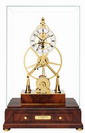 |
The Mayfair - Gold Plated Movement & Mahogany BaseH.21"(53CM) W.13"(34CM) D.10"(25CM) The Mayfair is based on a timepiece originally made in France, an elegant design popularly referred to as the 'Great Wheel'. During the Victorian period these skeleton clocks became very fashionable, particularly due to their prominence at the Great Exhibition in 1851. The simplicity of the movement is achieved by omitting a wheel and making compensating changes to the gear train. This handmade fusee movement is a traditional presentation of the Mayfair with the gold plated movement and mahogany base. £7950.00 G.B. Pounds |
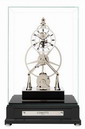 |
The Mayfair - Rhodium Plated Movement & Black Lacquer BaseH.21"(53CM) W.13"(34CM) D.10"(25CM) The Mayfair is based on a timepiece originally made in France, an elegant design popularly referred to as the 'Great Wheel'. During the Victorian period these skeleton clocks became very fashionable, particularly due to their prominence at the Great Exhibition in 1851. The simplicity of the movement is achieved by omitting a wheel and making compensating changes to the gear train. This handmade fusee movement is an elegant contemporary version of the Mayfair combining the rhodium plated movement with a piano finish black lacquer base. £8175.00 G.B. Pounds |
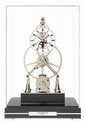 |
The Mayfair - Rhodium Plated Movement & Carbon Fibre BaseH.19"(48CM) W.13"(32CM) D.9"(23CM) The Mayfair is based on a timepiece originally made in France, an elegant design popularly referred to as the 'Great Wheel'. During the Victorian period these skeleton clocks became very fashionable, particularly due to their prominence at the Great Exhibition in 1851. The simplicity of the movement is achieved by omitting a wheel and making compensating changes to the gear train. This handmade fusee movement is a stunning contemporary version of the Mayfair with the rhodium plated movement mounted onto a gloss lacquered carbon fibre base. £8795.00 G.B. Pounds |
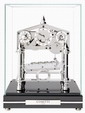 |
The Congreve - Rhodium Plated Movement & Carbon Fibre BaseH.14"(35CM) W.10"(25CM) D.10"(25CM) The Congreve, or Rolling Ball Clock, is named after its inventor Sir William Congreve (1772-1828) and is a favourite of clock collectors. The original clock was presented to the Prince of Wales in 1808 and is part of the Royal Collection at Buckingham Palace. Congreve was a prolific inventor famous for making the first solid fuel rockets at the Royal Arsenal in Woolwich in 1805 and subsequently used during the Napoleonic wars. It has been suggested that his clock was created for military purposes and the first "ball" used to trip the escapement was a musket ball. This certainly makes sense because the principle of the mechanism is such that the accuracy is limited to +/- 15 minutes per day. This timepiece is a stunning contemporary version of the Congreve with the rhodium plated movement mounted onto a gloss lacquered carbon fibre base. £10,175.00 G.B. Pounds |
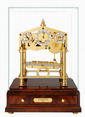 |
The Congreve - Gold Plated Movement & Mahogany BaseH.15"(39CM) W.10"(26CM) D.10"(26CM) The Congreve, or Rolling Ball Clock, is named after its inventor Sir William Congreve (1772-1828) and is a favourite of clock collectors. The original clock was presented to the Prince of Wales in 1808 and is part of the Royal Collection at Buckingham Palace. Congreve was a prolific inventor famous for making the first solid fuel rockets at the Royal Arsenal in Woolwich in 1805 and subsequently used during the Napoleonic wars. It has been suggested that his clock was created for military purposes and the first "ball" used to trip the escapement was a musket ball. This certainly makes sense because the principle of the mechanism is such that the accuracy is limited to +/- 15 minutes per day. This timepiece is a classic presentation of the Congreve with the gold plated movement mounted onto a mahogany base. £9850.00 G.B. Pounds |
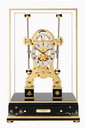 |
Limited Edition Navigator - Gold Plated With Chinoiserie ArtworkH.21"(53CM) W.13"(34CM) D.10"(25CM) The limited edition Navigator is a tribute to the extraordinary contribution John Harrison's marine chronometer made to the history of Great Britain and other maritime nations. His invention gave the British navies an enormous advantage in the quest for trade, exploration, and Empire. For this strictly limited edition Navigator Comitti's artist has harnessed the exquisite techniques of Chinoiserie artwork to create a panorama featuring celebrated scenes from British naval history. Each artwork is unique and signed by the artists. The panels depict Admiral Horatio Nelson's Royal Navy bearing down upon the French and Spanish galleons at the Battle of Trafalgar in 1805, the famous tea clipper Cutty Sark turning at last for home after a long and arduous trading voyage and HMS Beagle carrying Charles Darwin on his own momentous voyage of discovery to the Galapagos Islands in the 1830s. A limited edition of 50 pieces worldwide makes this Navigator a highly collectable timepiece. Each piece is numbered and supplied with a Certificate of Authenticity. Limited stock available £13,750.00 G.B. Pounds |
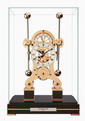 |
Limited Edition Navigator - Rose Gold With Carbon Fibre BaseH.19"(48CM) W.13"(32CM) D.9"(23CM) The Navigator is a tribute to clockmaker John Harrison (1693-1776) who made the world's first marine chronometer. His unique timepieces made it possible for the first time for British naval officers to accurately calculate their longitude position. This technical breakthrough gave an extraordinary advantage to the navies of Great Britain in their quest for global exploration, trade, and Empire. This unique story is revealed by Dava Sobel's best-selling book and the movie "Longitude". The rhythmic movement of the pendulum balances brings the Navigator to life. This flagship product is handmade in Comitti workshops and is a stunning contemporary version of the Navigator combining a rose gold plated movement with a gloss lacquered carbon fibre base. A limited edition of only 25 pieces worldwide. Limited stock available £11,990.00 G.B. Pounds |
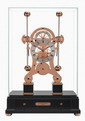 |
Limited Edition Navigator - Rose Gold With Black Lacquer BaseH.21"(53CM) W.13"(34CM) D.10"(25CM) The Navigator is a tribute to clockmaker John Harrison (1693-1776) who made the world's first marine chronometer. His unique timepieces made it possible for the first time for British naval officers to accurately calculate their longitude position. This technical breakthrough gave an extraordinary advantage to the navies of Great Britain in their quest for global exploration, trade, and Empire. This unique story is revealed by Dava Sobel's best-selling book and the movie "Longitude". The rhythmic movement of the pendulum balances brings the Navigator to life. This flagship product is handmade in Comitti workshops and is a stunning contemporary version of the Navigator combining a rose gold plated movement with piano high gloss black lacquered base. A limited edition of only 50 pieces worldwide. Limited stock available £11,985.00 G.B. Pounds |
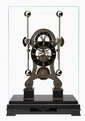 |
The Navigator - Black Chrome Plated With Carbon Fibre BaseH.19"(48CM) W.13"(32CM) D.9"(23CM) The Navigator is a tribute to clockmaker John Harrison (1693-1776) who made the world's first marine chronometer. His unique timepieces made it possible for the first time for British naval officers to accurately calculate their longitude position. This technical breakthrough gave an extraordinary advantage to the navies of Great Britain in their quest for global exploration, trade, and Empire. This unique story is revealed by Dava Sobel's best-selling book and the movie "Longitude". The rhythmic movement of the pendulum balances brings the Navigator to life. This flagship product is handmade in Comitti workshops and is a unique contemporary version of the Navigator combining a black chrome plated movement with a gloss lacquered carbon fibre base. £11,950.00 G.B. Pounds |
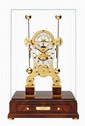 |
The Navigator - Gold Plated With Mahogany BaseH.21"(53CM) W.13"(34CM) D.10"(25CM) The Navigator is a tribute to clockmaker John Harrison (1693-1776) who made the world's first marine chronometer. His unique timepieces made it possible for the first time for British naval officers to accurately calculate their longitude position. This technical breakthrough gave an extraordinary advantage to the navies of Great Britain in their quest for global exploration, trade, and Empire. This unique story is revealed by Dava Sobel's best-selling book and the movie "Longitude". The rhythmic movement of the pendulum balances brings the Navigator to life. This flagship product is handmade in Comitti workshops and is a classic presentation of the Navigator grasshopper timepiece combining the gold plated movement and mahogany base. £10,365.00 G.B. Pounds |
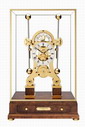 |
The Navigator - Gold Plated With Walnut BaseH.21"(53CM) W.13"(34CM) D.10"(25CM) The Navigator is a tribute to clockmaker John Harrison (1693-1776) who made the world's first marine chronometer. His unique timepieces made it possible for the first time for British naval officers to accurately calculate their longitude position. This technical breakthrough gave an extraordinary advantage to the navies of Great Britain in their quest for global exploration, trade, and Empire. This unique story is revealed by Dava Sobel's best-selling book and the movie "Longitude". The rhythmic movement of the pendulum balances brings the Navigator to life. This flagship product is handmade in Comitti workshops and is an elegant traditional presentation of the Navigator combining the gold plated movement, burr walnut base, and gold plated framed canopy. £11,125.00 G.B. Pounds |
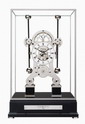 |
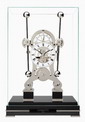
The Navigator - Rhodium Plated With Black Lacquer BaseH.21"(53CM) W.13"(34CM) D.10"(25CM) The Navigator is a tribute to clockmaker John Harrison (1693-1776) who made the world's first marine chronometer. His unique timepieces made it possible for the first time for British naval officers to accurately calculate their longitude position. This technical breakthrough gave an extraordinary advantage to the navies of Great Britain in their quest for global exploration, trade, and Empire. This unique story is revealed by Dava Sobel's best-selling book and the movie "Longitude". The rhythmic movement of the pendulum balances brings the Navigator to life. This flagship product is handmade in Comitti workshops and is a superb contemporary version of the Navigator combining the rhodium plated movement, black lacquer base and rhodium finish framed canopy. £11,125.00 G.B. Pounds |
 |
The Navigator - Rhodium Plated With Carbon Fibre BaseH.19"(48CM) W.13"(32CM) D.9"(23CM) The Navigator is a tribute to clockmaker John Harrison (1693-1776) who made the world's first marine chronometer. His unique timepieces made it possible for the first time for British naval officers to accurately calculate their longitude position. This technical breakthrough gave an extraordinary advantage to the navies of Great Britain in their quest for global exploration, trade, and Empire. This unique story is revealed by Dava Sobel's best-selling book and the movie "Longitude". The rhythmic movement of the pendulum balances brings the Navigator to life. This flagship product is handmade in Comitti workshops and is a stunning contemporary version of the Navigator combining the rhodium plated movement with a gloss lacquered carbon fibre base. £11,625.00 G.B. Pounds |
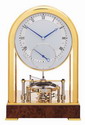 |
The Meridian - Gold Plated 8 Day Movement & Burr Walnut BaseH.11"(27CM) W.7"(18CM) D.5"(12.7CM) Inspired by the work of Dr. George Daniels CBE (1926-2011), the Meridian timepiece features a key wound movement with a power reserve of 8 days. This is a world first and a unique contribution to the art of mechanical clock making. With a limited edition of 500 pieces worldwide, each movement has a unique serial number engraved on the back plate and certificate of authenticity. This is a classic execution of the Meridian combining the gold plated movement with a burr walnut base. £11,500.00 G.B. Pounds |
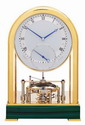 |
The Meridian - Gold Plated Year Going Movement & Malachite Gemstone BaseH.11"(27CM) W.7"(18CM) D.5"(12.7CM) Inspired by the work of Dr. George Daniels CBE (1926-2011), the Meridian timepiece features a jewelled version of his coaxial escapement and automatic winding system with a power reserve of 12 months. This is a world first and a unique contribution to the art of mechanical clock making. With a limited edition of 500 pieces worldwide, each movement has a unique serial number engraved on the back plate and certificate of authenticity. This is a stunning presentation of the Meridian featuring the gold plated movement with a Malachite gemstone base. £14,390.00 G.B. Pounds |
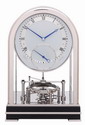 |
The Meridian - Rhodium Plated 8 Day Movement & Piano Finish Black Lacquer BaseH.11"(27CM) W.7"(18CM) D.5"(12.7CM) Inspired by the work of Dr. George Daniels CBE (1926-2011), the Meridian timepiece features a key wound movement with a power reserve of 8 days. This is a world first and a unique contribution to the art of mechanical clock making. With a limited edition of 500 pieces worldwide, each movement has a unique serial number engraved on the back plate and certificate of authenticity. This is a superb contemporary version of the Meridian combining the rhodium plated movement with a piano finish black lacquer base. £10,950.00 G.B. Pounds |
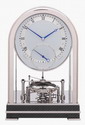 |
The Meridian - Rhodium Plated Year Going Movement & Gloss Lacquered Carbon Fibre BaseH.11"(27CM) W.7"(18CM) D.5"(12.7CM) Inspired by the work of Dr. George Daniels CBE (1926-2011), the Meridian timepiece features a jewelled version of his coaxial escapement and automatic winding system with a power reserve of 12 months. This is a world first and a unique contribution to the art of mechanical clock making. With a limited edition of 500 pieces worldwide, each movement has a unique serial number engraved on the back plate and certificate of authenticity. This is a stunning contemporary presentation of the Meridian timepiece featuring the rhodium plated movement mounted onto a gloss lacquered carbon fibre base. £12,500.00 G.B. Pounds |
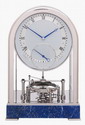 |
The Meridian -Rhodium Plated Year Going Movement & Lapis Gemstone BaseH.11"(27CM) W.7"(18CM) D.5"(12.7CM) Inspired by the work of Dr. George Daniels CBE (1926-2011), the Meridian timepiece features a jewelled version of his coaxial escapement and automatic winding system with a power reserve of 12 months. This is a world first and a unique contribution to the art of mechanical clock making. With a limited edition of 500 pieces worldwide, each movement has a unique serial number engraved on the back plate and certificate of authenticity. This is an exquisite version of the Meridian featuring the rhodium plated movement with a Lapis gemstone base. £14,390.00 G.B. Pounds |